How Bitesized English Training Improved A Care Home’s Documentation & Safeguarding
A specialist mental health nursing home in Rochdale improved incident reporting and care documentation through Lingly's job-specific English training—saving management hours and strengthening compliance.
- Staff Enrolled
- 14
- Total Learning Hours
- 171+
- Care Notes Practised
- 246
- Words Spoken
- 108,000+


Before, an incident report would just say 'resident fell'. We'd have to wait days for that staff member to come back on shift to find out what actually happened. Now we read the care notes and we know immediately.
Taking Documentation Seriously
This specialist nursing home in Rochdale supports adults with complex care and mental health needs. Care notes here aren't just records—they're legal documents shared with CQC, safeguarding teams, and families. Most homes accept that as an unavoidable admin burden. This one decided to fix it.
"Before it would just say 'yes, resident has fallen'. Now we've got a lot more information on the incident report. From our point of view, the incident forms are a massive difference. Massive difference."
— Management Team, a complex care home in Rochdale
The Solution: Care-Specific English That Fits Around Shifts
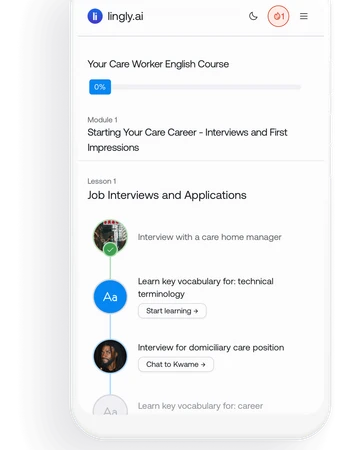
Lingly partnered with a complex care home in Rochdale to deliver practical English training focused on documentation and communication. Staff practised writing care notes, describing incidents, and having conversations with residents and families—all through realistic AI scenarios they could complete on their phones, whenever suited their schedule.
-
Care Notes That Meet Compliance Standards
Staff practised writing detailed incident reports, activity logs, and handover notes—getting instant feedback on clarity and completeness
-
De-escalation and Family Conversations
Realistic roleplay scenarios with AI residents and families, helping staff build confidence in difficult conversations
-
Grammar That Changes Meaning
Focused practice on punctuation and sentence structure—because in care documentation, grammar isn't pedantry, it's precision
-
Fits Around Any Shift Pattern
15-minute daily practice sessions that work with any schedule—night shifts, split shifts, or days off
"At night, when I'm less busy, I spend 20 or 30 minutes on the app just to progress more." — Felicia
Why Traditional Solutions Don't Work for Care Homes
Traditional ESOL classes weren't designed for shift workers who need immediate, practical care communication skills.
-
Fixed schedules don't work
-
With rotating shifts, night work, and 24/7 care, staff can't commit to weekly classes at set times
-
Generic content misses the mark
-
Staff need to learn care-specific terminology and UK colloquialisms, not essay writing or textbook grammar
-
Cost and logistics
-
At £4,000-8,000 per person for workplace English, traditional ESOL is prohibitively expensive for care homes
On the day we closed the pilot, we had loads of emails—'I can't get on the course, I can't log in.' We had to tell them it's finished. They didn't want to stop.
The Results: Engagement That Surprised Everyone
Management admitted they didn't expect it to go this well.
- Total Learning Time
- 171+ hours
- Care Notes Practised
- 246
- Vocabulary Learnt
- 3,145
- AI Conversations
- 339
Miriam
Care Worker
"My English has improved so much. When talking to residents now, I don't have to repeat myself twice for them to understand me. It's made my care notes easier to write too."

Felicia
Care Worker
"The app showed me so many mistakes I'd been making. Before, I would just type and send without checking. Now I understand that you need to proofread, check what you've written, and make corrections in a professional way. It's improved my care notes so much—I feel more confident because I learn something new every time I use it."

Chasing Staff for Information
Incident reports lacked detail, creating delays and compliance headaches
-
Basic incident reports — "resident fell" with no context
-
Waiting for staff to return to shift for clarification
-
Hesitant to share care notes with CQC and families
-
Grammar and punctuation changing the meaning of notes
-
Staff avoiding difficult conversations with families
Documentation Ready for Compliance
Incident reports now contain everything needed for safeguarding & staff are better equiped to handle all situations
-
Detailed incident forms — what happened, response, de-escalation
-
Safeguarding reports completed immediately from notes
-
Staff ready to progress in their care careers
-
More professional and meaningful care notes
-
Staff more comfortable approaching and de-escalating situations
As a complex care service, we need clear documentation of how we support challenging behaviours. Now we're confident sharing our care notes with external safeguarding teams and families—that simply wasn't possible before.
Supporting complex care staff with practical English training?
Give your team the language skills to document incidents properly, communicate with families confidently, and meet compliance requirements. Lingly's care-specific platform fits around any shift pattern.